
Notes from the range,
the cart, and the recovery couch
Short posts from FitCaddie on getting your body ready for the next round: mobility, pain, distance, warm-ups, recovery, and mindset.
12 of 12 posts
The 10-minute golf warm-up routine, range or no range
Ten minutes of movement before you tee off, in order, with a range version and a parking-lot version. Ehlert and Wilson (2019) pooled 23 golf warm-up studies: dynamic wins, static stretching loses.
Golf strength exercises: a 2-day plan you can keep
Two sessions a week, 6 lifts, 8 weeks. Uthoff and colleagues (2021) reviewed 20 studies: general lifting plus golf-specific speed work averaged 4.1 percent more clubhead speed, general lifting alone 1.6 percent.
The 8 golf exercises worth doing twice a week
Clubhead speed comes from the legs. Brennan et al. (2024) pooled 20 studies and found jump impulse the strongest physical correlate of speed, and flexibility not significant. Here are 8 exercises, grouped by job.
Golf stretches that earn a spot in your week
The stretches worth your time open the ranges the swing loads hardest. Murray et al. (2009) found amateur golfers with low back pain had 10 degrees less lead-hip rotation. Here are 6, and when to do each.
Golfer's elbow exercises: 5 slow moves, plus when to keep playing
Golfer's elbow is an overloaded tendon, and the small studies we have point to slow daily loading. Tyler et al. (2014) saw disability scores fall from 34.7 to 7.9 after adding one eccentric drill to standard care.
One floor drill for three swing faults: thoracic rotation
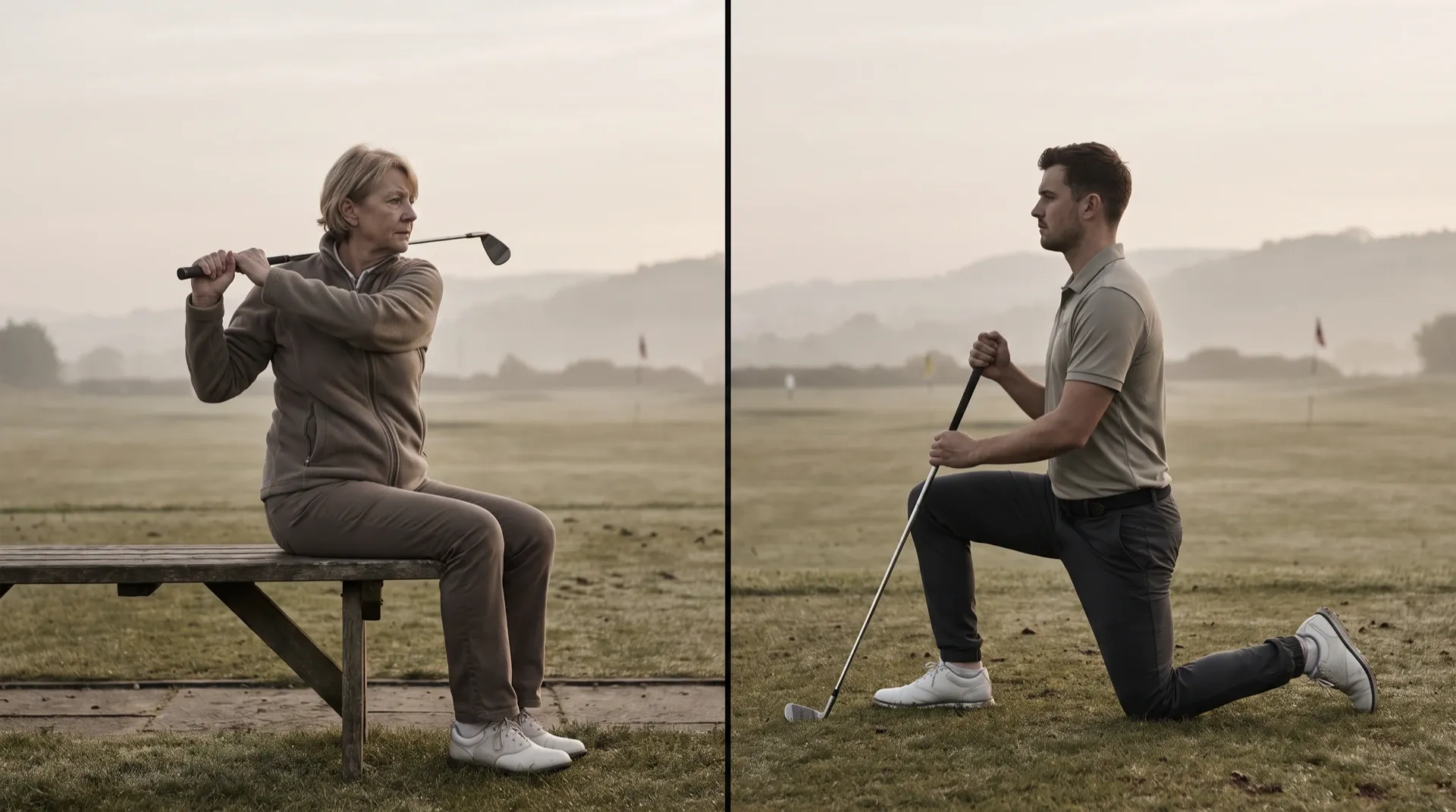
Early extension, casting, and a fall-back finish often share a single cause, a mid-back that won't rotate. A 60-second seated test tells you if that's you, and the open book drill works on it in 4 minutes a day.
The 90/90 you've been doing wrong (and the fix)
The 90/90 hip switch is one of the most-prescribed mobility drills for golfers and one of the most-butchered. Three mistakes kill it. This is the version that changes your hip rotation, and why hip rotation matters for your low back.
Lower back twinges on the back nine: a 3-minute mid-round reset
A tight, hot band across the low back around hole 12 is usually accumulated load. Three movements you can do against the cart, about 3 minutes total, plus the signs that mean stop playing and the one that means go to the ER.
Why your X-factor stopped growing at 45, and how to restart it
X-factor is the gap between hip and shoulder rotation at the top of the backswing. Myers et al. (2008) found the fastest golfers carried 15 degrees more of it. Older golfers measure smaller, and more stretching misses the cause. Three drills restart it.
The 7-minute parking-lot warm-up for cold mornings
When it's 45 degrees at the first tee, a few practice swings do little for cold tissue. This minute-by-minute dynamic warm-up needs no range and one club, and it skips the static stretching Gergley (2009) found cut clubhead speed and accuracy.
What 'active recovery' actually means after 18 holes
Active recovery is low-intensity movement after exercise instead of sitting still. For golf, that's 20 minutes of easy walking, slow mobility, and breathing in the half hour after your round. Dupuy et al. (2018) found it eases delayed-onset soreness. This is the protocol, and what it won't do.
The pre-shot routine that survives bogey-bogey-double
A pre-shot routine that holds up after a bad stretch has three anchors: a fixed physical sequence, one breath, and a short verbal cue. Rupprecht, Tran and Gröpel's 2021 meta-analysis found routines help under pressure as much as without it.