
The 7-minute parking-lot warm-up for cold mornings
When it's 45 degrees at the first tee, a few practice swings do little for cold tissue. This minute-by-minute dynamic warm-up needs no range and one club, and it skips the static stretching Gergley (2009) found cut clubhead speed and accuracy.
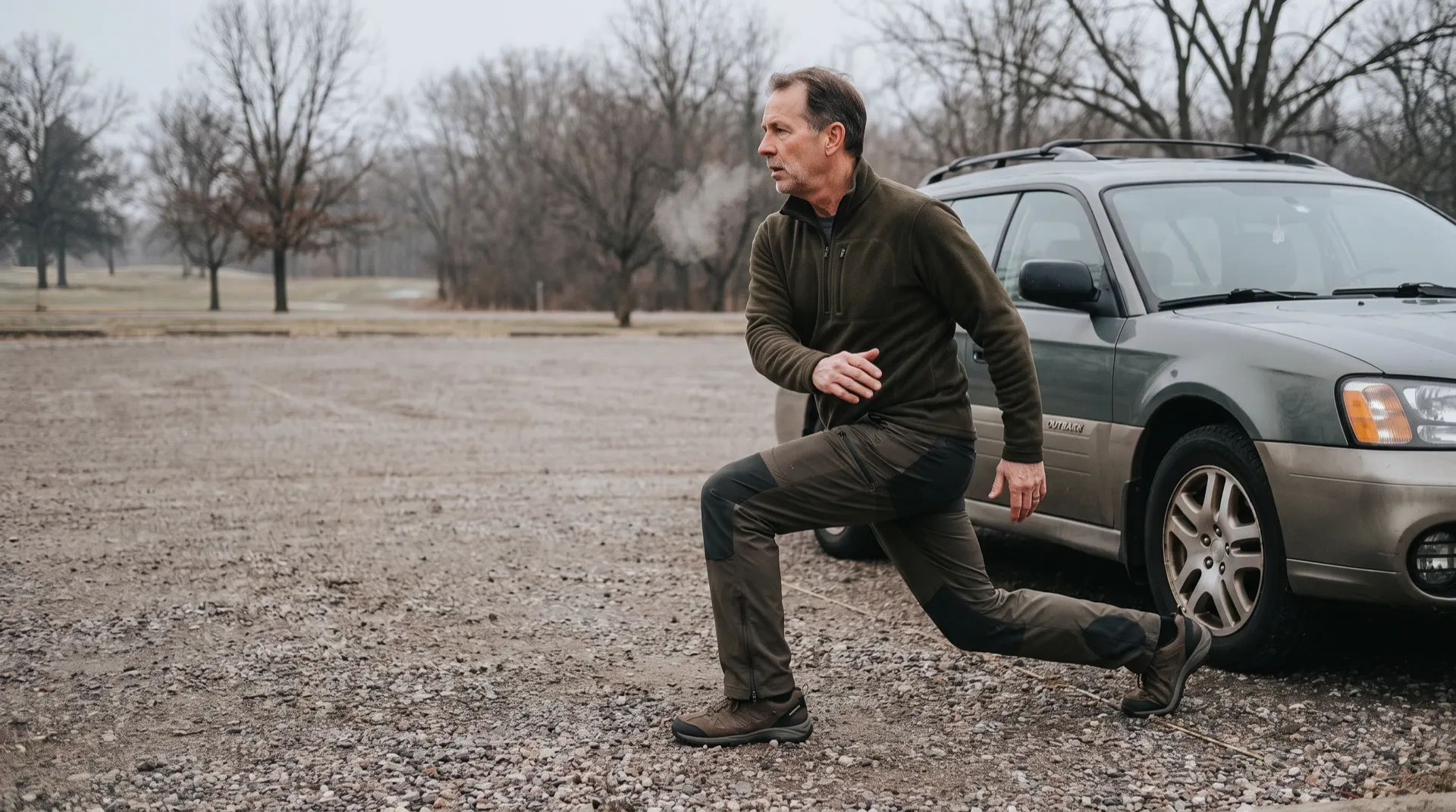
Cold tissue moves less freely, and the first tee on a 45-degree morning is a bad place to find out how much less. This 7-minute routine raises your body temperature and rehearses the swing pattern before you have to hit a shot that counts. You need a parking lot and one club.
Why "a few practice swings" doesn't count
Fradkin, Finch and Sherman (British Journal of Sports Medicine, 2001) observed 1,040 amateur golfers at a private course, a public course and a driving range. 54.3 percent did any form of preparation, and of those, 88.7 percent were swinging a club in the air on the tee. Their own conclusion: only a small proportion of amateur golfers perform appropriate warm-up exercises.
The same group then tested what a real warm-up does (British Journal of Sports Medicine, 2004). Ten golfers who did a short golf-specific routine gained 12.8 percent of clubhead speed between their week-1 and week-2 tests. After 5 weeks of doing it 5 times a week, their speed was up 24 percent from their own starting point, while 10 matched controls barely changed. One honest note: the 2004 paper doesn't break its routine into parts, so it can't tell you which ingredient did the work, and clubhead speed was the only thing it measured. The study below is the one that isolates stretching.
Tilley and Macfarlane (International Journal of Sports Physical Therapy, 2012) compared three warm-ups in elite male golfers. Adding 10 minutes of band-resisted rotations to a standard club warm-up improved maximal driving distance, smash factor and consistent ball strike over the club warm-up alone. Clubhead speed and driving accuracy didn't change. Moving the body through rotation before the swings helped the swings. One thing to carry: the abstract says 15 golfers, but the methods section says 12 of the 15 finished, so it's a 12-golfer result.
The first part of all this takes 7 minutes.
Skip the static stretching
Holding stretches before you swing feels productive. Gergley (Journal of Strength and Conditioning Research, 2009) tested it: 15 young competitive golfers did a 20-minute passive static stretching routine followed by a club warm-up, versus the same club warm-up alone. Adding the static stretching cut clubhead speed by 4.19 percent, distance by 5.62 percent, accuracy by 31.04 percent, and consistent contact by 16.34 percent. A follow-up (Gergley, 2010) tracked how long it lasted: speed had recovered by about 45 minutes, but distance and contact quality were still down at 60 minutes, which on a course is roughly 6 holes.
Everything below is dynamic. You move through a range and out of it. You don't hold.
The 7-minute flow
- Minutes 1 and 2: brisk walk with arm circles. Walk for 2 full minutes, fast enough to feel your breathing pick up. Loop the parking lot, the cart path, whatever's there. Swing both arms in big forward circles for the first stretch, backward for the second, alternating for the rest. An active warm-up raises muscle and core temperature, and our coaching view is that the walk is doing most of that job here. Don't cut it short on a cold morning.
- Minute 3: 10 bodyweight squats, arms reaching forward. Feet shoulder width, sit down and back like you're finding a chair, arms straight out in front for balance. Go as deep as is comfortable. This wakes up the hips, knees and ankles you'll need for ground force.
- Minute 4: 10 reverse lunges with rotation. Step one foot back into a lunge, then turn your torso toward the front leg and back to center. Alternate legs, 5 each side. This links hip stability with trunk rotation, which is the golf swing in slow motion.
- Minute 5: 10 standing thoracic rotations, club across the shoulders. Hold a club behind your neck across your shoulders. Get into your golf posture. Rotate right as far as you can, then left. Slow. Keep the hips quiet so the mid-back does the work. (If you failed the 45-degree seated test, spend an extra 30 seconds here.)
- Minute 6: 10 slow half-swings, each one a little fuller. Wedge or 7-iron. Start at hip height and let each swing get a bit longer. You're rehearsing the pattern.
- Minute 7: 5 three-quarter swings with a 7-iron. Near-full speed, full rhythm, balanced finish. This is your first tee shot, done five times where a miss doesn't count.
By the time you tee off, you've warmed up. The first drive feels like your sixth swing of the day.
Adjust for the weather
Below 40 degrees, walk for 3 minutes instead of 2 and keep your jacket on through minute 5. That makes it an 8-minute routine. Above 70, you can trim the walk to a minute, but keep it. In our experience the walk is the part golfers skip first, and the part that does the most.
What to do tomorrow
Practice the flow at home once so you're not reading your phone in the parking lot. If the morning isn't cold, the generic 10-minute routine is the same idea with less walking and a range version. Then run it before your next round and notice how the first tee shot feels compared with your usual. If your low back is the thing that shows up mid-round, pair this with the 3-minute cart reset.
FitCaddie's Play tab has a pre-round warm-up built on this flow, and the Balanced Golf-Body program builds round-day prep into the week automatically.
Sources
- Fradkin AJ, Finch CF, Sherman CA. Warm up practices of golfers: are they adequate? British Journal of Sports Medicine. 2001;35(2):125-127. doi:10.1136/bjsm.35.2.125
- Fradkin AJ, Sherman CA, Finch CF. Improving golf performance with a warm up conditioning programme. British Journal of Sports Medicine. 2004;38(6):762-765. doi:10.1136/bjsm.2003.009399
- Gergley JC. Acute effects of passive static stretching during warm-up on driver clubhead speed, distance, accuracy, and consistent ball contact in young male competitive golfers. Journal of Strength and Conditioning Research. 2009;23(3):863-867. PubMed 19387392
- Gergley JC. Latent effect of passive static stretching on driver clubhead speed, distance, accuracy, and consistent ball contact in young male competitive golfers. Journal of Strength and Conditioning Research. 2010;24(12):3326-3333.
- Tilley NR, Macfarlane A. Effects of different warm-up programs on golf performance in elite male golfers. International Journal of Sports Physical Therapy. 2012;7(4):388-395. PMC3735827
Questions golfers ask
Should I stretch before golf?
Not static stretching. Gergley (2009) found that adding a 20-minute passive static stretching routine before a club warm-up cut clubhead speed 4.19 percent, distance 5.62 percent, and accuracy 31.04 percent compared with the club warm-up alone. Move dynamically instead: walking, squats, lunges, rotations, then swings that build up gradually.
How long should a golf warm-up be?
Seven to 10 minutes of dynamic movement is our coaching target. For reference, the short golf-specific routine in Fradkin, Sherman and Finch (2004) took about 5 minutes and produced a 12.8 percent clubhead speed gain between the golfers' week-1 and week-2 tests. Clubhead speed was the only outcome that study measured, so treat the time as a floor rather than a target, and give the walk whatever the weather asks for.
What if I only have 2 minutes before my tee time?
Do minutes 4, 6 and 7 from the routine at a faster clip: reverse lunges with rotation, then slow half-swings building into three-quarter swings. Skip the walk. Two minutes of that beats two minutes of standing still.
Continue reading
More on Warm-up
Read a guide, then run the routine.
Open FitCaddie for a short routine you can run before your next round.
Build my planNo inbox required · 7 days free · No card to start