
The 8 golf exercises worth doing twice a week
Clubhead speed comes from the legs. Brennan et al. (2024) pooled 20 studies and found jump impulse the strongest physical correlate of speed, and flexibility not significant. Here are 8 exercises, grouped by job.
The exercises that add clubhead speed make your legs push harder against the ground, then teach them to do it fast. Squats, hinges, jumps and rotational throws sit at the top of that list. Stretching keeps you comfortable and gives the swing room to happen, and on its own it does not appear to move the club any faster.
Brennan and colleagues (Sports Medicine, 2024) screened 3,039 studies, kept 20, and pooled how each physical test related to driver clubhead speed. Jump impulse produced the strongest association at zr = 0.82, ahead of upper body explosive strength at 0.67 and jumping peak power at 0.66. Lower body strength (0.47) and upper body strength (0.48) landed in the middle. Flexibility came out at -0.04, with a confidence interval straddling zero.
Those are z-transformed correlations, so read them against each other rather than as plain r values.
What clubhead speed is made of
Chu, Sell and Lephart (Journal of Sports Sciences, 2010) ran 308 golfers through motion capture and force plates and built regression models at 4 points in the swing. The models accounted for 44 to 74 percent of the variance in ball velocity. The variables that mattered were torso-pelvis separation, a delayed release of the arms and wrists, trunk forward and lateral tilt, and weight shifting through the swing.
Three of those four are trainable off the course. Separation is your X-factor. Weight shift is leg strength plus the willingness to use it. Trunk tilt is a shape your trunk holds while everything else moves.
Where the speed enters your body
Han and colleagues (Sports Biomechanics, 2019) recorded 63 male golfers off 3 handicap or better on 2 force plates. Peak forces under the lead foot, in all 3 directions, correlated with clubhead speed, and so did the pivoting moment under the trail foot. The heaviest loading landed near the instant the lead arm is parallel to the ground on the way down.
Honest limit: low-handicap men, and a correlation inside a single swing sample is not a training effect. What it does pin down is where the force gets in, which is under your feet.
Why flexibility missed the list
Brennan's review does not say which flexibility tests were pooled, so keep the reading narrow. Flexibility scores did not track clubhead speed across those 20 studies. Mobility earns its keep somewhere else. The 6 stretches that deserve a spot in your week pay off in a lead hip that isn't running at the edge of its range and a back that lets you get to the top.
The trunk's job is holding a shape
Lindsay and Horton (North American Journal of Sports Physical Therapy, 2006) tested trunk rotation on an isokinetic dynamometer in 40 non-golfing controls, 32 healthy elite golfers, and 7 elite golfers with low back pain. Peak torque showed no significant difference anywhere, within groups or between them. The golfers with pain were short on endurance in the non-dominant direction, which is the follow-through side of the swing.
Seven golfers is a tiny pain group, so hold it loosely. It still points trunk work toward holding a position while something tries to move you, and toward endurance over a big peak number.
The 8 exercises
Nothing here should pinch or produce sharp pain. Stop the movement that does, and see a physio before you try it again. Start every one of these lighter than you think you need to for the first 2 weeks.
Force: the legs and hips
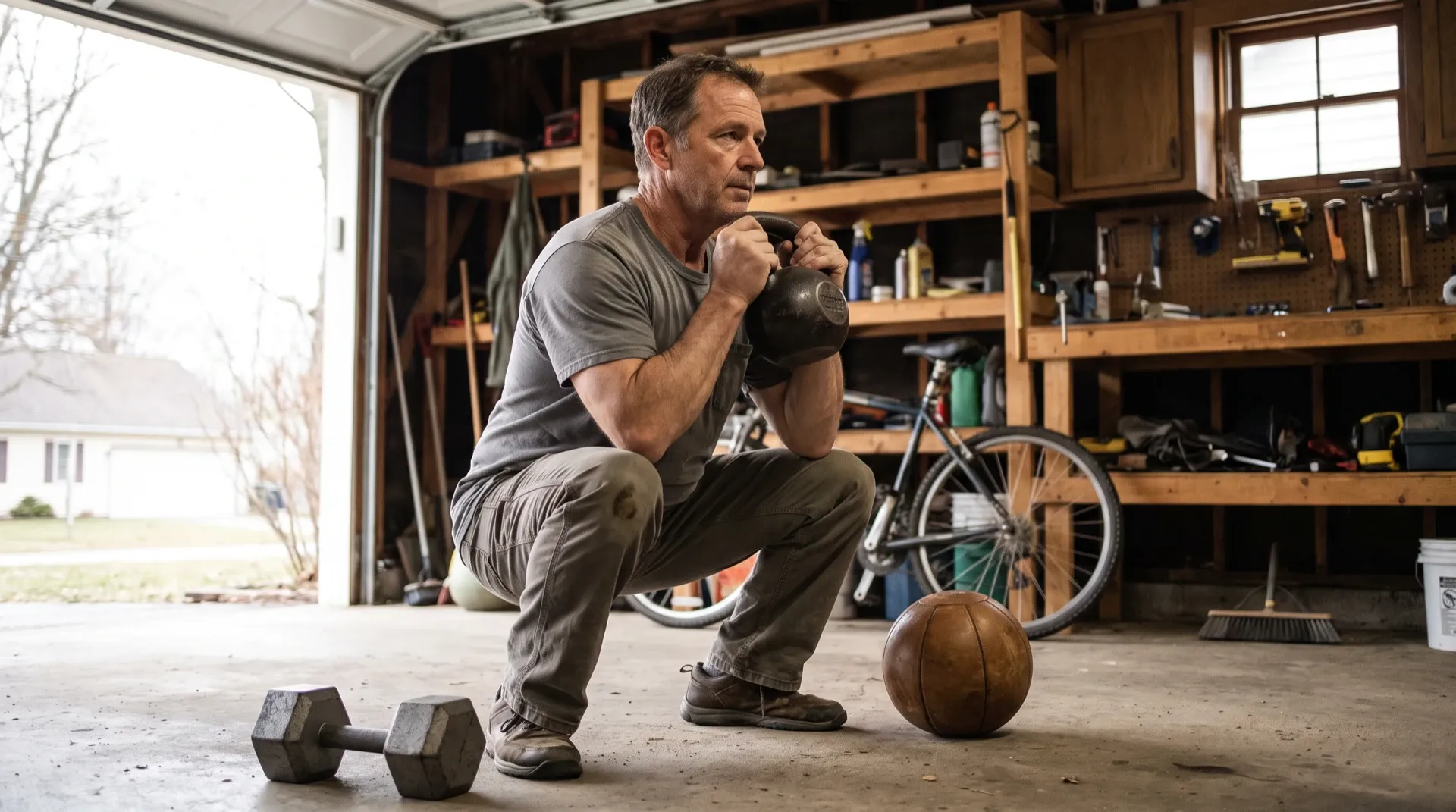
- Goblet squat. 3 sets of 8, one dumbbell or kettlebell held at your chest. Sit down between your feet with your chest tall and your heels flat. The weight out front acts as a counterbalance, which is why this is the squat we start golfers on instead of a bar on the back.
- Romanian deadlift. 3 sets of 8. Soft knees, weight in both hands, push your hips back until the hamstrings load, then stand with your back flat the whole way. This is the pattern that lets you push the ground away without your low back doing the pushing.
- Split squat. 2 sets of 8 per leg, one foot forward, back knee lowering straight down toward the floor. Front shin stays close to vertical. Han's team recorded the lead foot doing its own job, and the downswing asks the two legs for different work at different moments.
- Countermovement jump. 3 sets of 5, with a full reset between reps: dip fast, jump, land quiet. Jump impulse topped Brennan's pooled list, and jumping is the ordinary way to train it, though the jump is a test before it is an exercise and no trial has shown jumping alone raises clubhead speed. Swap in a fast step-up onto a low box if it bothers your knees.
Speed: the rotation
- Rotational medicine ball throw. 3 sets of 5 per side, standing side-on about 6 feet from a solid wall. Push off the back foot, let the hips go first, and throw it hard enough that catching it is a nuisance. Pick a ball you can still throw fast, which for the golfers we work with usually starts around 4 to 8 pounds, and go heavier only when the throw stops looking quick.
- Half-kneeling rotational throw. 2 sets of 5 per side, same ball, kneeling on your trail knee. Kneeling takes the legs out of it so the hips and trunk have to make the speed themselves. It's the fast cousin of the half-kneeling rotation drill you'd use to build separation.
Shape: the trunk that holds it
- Pallof press. 3 sets of 8 per side, holding 3 seconds at the end of each rep. Band or cable anchored at chest height, stand side-on, press straight out in front of you and refuse to turn. The hold is where the endurance Lindsay and Horton measured lives.
- Suitcase carry. 3 walks of 30 seconds per side, one heavy dumbbell in one hand. Stand tall, shoulders level, no leaning away from the weight. Same job as the Pallof press with your feet moving, which is closer to what the swing asks for.
Two sessions a week is the floor
Thompson, Cobb and Blackwell (Journal of Strength and Conditioning Research, 2007) randomly assigned 18 male golfers averaging 70.7 years old to 8 weeks of functional training, mixing flexibility, core stability, balance and resistance work, or to a control group. Maximum clubhead speed in the training group rose from 127.3 to 133.6 km/h, close to 5 percent. The control group drifted from 134.5 down to 133.3. Eighteen men is a small trial, and it is still the closest the literature comes to the golfer reading this post.
The younger evidence points the same way. Doan, Newton, Kwon and Kraemer (2006) trained 16 Division I golfers 3 times a week for 11 weeks: every strength, power and flexibility test improved between 7.3 and 19.9 percent, and clubhead speed rose 1.6 percent, worth about 4.9 meters of drive. Oranchuk and colleagues (2020) gave 12 collegiate golfers 8 weeks of either barbell strength and power work or a bodyweight and rotational program, and the barbell group gained more average clubhead speed, squat, power clean and jump height than the controls. Across all 12 golfers, clubhead speed tracked the countermovement jump (r = 0.73), the power clean (r = 0.70) and the back squat (r = 0.64).
Our coaching view is 2 sessions a week, which is the number the golfers we work with keep past February: exercises 1, 2, 5 and 7 on Day A, and 3, 4, 6 and 8 on Day B. Keep both days at least 2 days clear of a round that matters.
Go deeper
- Why your X-factor stopped growing at 45: the separation Chu's models kept finding, and the 3 drills that rebuild it.
- Golf stretches that earn a spot in your week: the mobility side of the bill, with the lead-hip test that comes first.
- The 45-degree seated test: how much mid-back rotation you need before rotational throws are worth doing.
What to do tomorrow
Run Day A: goblet squat, Romanian deadlift, rotational throw, Pallof press. With a warm-up it's about 25 minutes, and the first session should feel too easy. Give it 8 weeks before you judge whether your driver noticed.
FitCaddie's Distance & Speed program sequences this work across 8 weeks at 10 to 15 minutes a day, with the mobility that comes first built into the same plan.
Sources
- Brennan A, Murray A, Mountjoy M, et al. Associations between physical characteristics and golf clubhead speed: a systematic review with meta-analysis. Sports Medicine. 2024;54(6):1553-1577. doi:10.1007/s40279-024-02004-5
- Chu Y, Sell TC, Lephart SM. The relationship between biomechanical variables and driving performance during the golf swing. Journal of Sports Sciences. 2010;28(11):1251-1259. doi:10.1080/02640414.2010.507249
- Han KH, Como C, Kim J, et al. Effects of the golfer-ground interaction on clubhead speed in skilled male golfers. Sports Biomechanics. 2019;18(2):115-134. doi:10.1080/14763141.2019.1586983
- Lindsay DM, Horton JF. Trunk rotation strength and endurance in healthy normals and elite male golfers with and without low back pain. North American Journal of Sports Physical Therapy. 2006;1(2):80-89. PubMed 21522218
- Oranchuk DJ, Mannerberg JM, Robinson TL, Nelson MC. Eight weeks of strength and power training improves club head speed in collegiate golfers. Journal of Strength and Conditioning Research. 2020;34(8):2205-2213. doi:10.1519/JSC.0000000000002505
- Thompson CJ, Cobb KM, Blackwell J. Functional training improves club head speed and functional fitness in older golfers. Journal of Strength and Conditioning Research. 2007;21(1):131-137. doi:10.1519/00124278-200702000-00024
- Doan BK, Newton RU, Kwon YH, Kraemer WJ. Effects of physical conditioning on intercollegiate golfer performance. Journal of Strength and Conditioning Research. 2006;20(1):62-72. doi:10.1519/R-17725.1
Questions golfers ask
What exercises increase golf swing speed?
Squats, hinges, jumps and rotational medicine ball throws have the best case behind them. Brennan and colleagues (2024) pooled 20 studies and found clubhead speed most strongly associated with jump impulse, then upper body explosive strength and jumping peak power. Oranchuk and colleagues (2020) put 12 collegiate golfers through 8 weeks of barbell strength and power work, and that group gained more average clubhead speed than the control group did. Thompson and colleagues (2007) raised clubhead speed close to 5 percent with 8 weeks of training in golfers averaging 70 years old, so this is not a young player's list.
How many times a week should a golfer work out?
Two full sessions a week covers most recreational golfers, and our coaching view is that 2 done every week beats 4 planned and skipped. The training studies that moved clubhead speed ran heavier: Doan and colleagues (2006) trained golfers 3 times a week for 11 weeks, and the 8-week programs in Thompson (2007) and Oranchuk (2020) were supervised the whole way. Short mobility work fits on the other days. Keep hard lifting off the 2 days before a round you care about.
Do golfers need to lift heavy weights?
Heavy enough that the last rep of a set is hard, which is a long way from a one-rep max. In Oranchuk and colleagues (2020) the group doing high-load barbell work improved average clubhead speed while the group doing bodyweight and rotational training did not, and clubhead speed correlated with the power clean at r = 0.70, the countermovement jump at r = 0.73 and the back squat at r = 0.64. That was 12 college golfers, so the direction is more trustworthy than the numbers.
Should I do these exercises if my back hurts?
See a physio first if the pain is sharp, travels down a leg, or has been there more than a couple of weeks. Numbness, leg weakness, or any change in bladder or bowel control means stop training and call a doctor the same day. Once you have the all clear, start with the trunk work rather than the heavy lifting: a Pallof press and a suitcase carry, both of which train holding a position instead of twisting under load. Lindsay and Horton (2006) found golfers with low back pain were short on trunk rotation endurance rather than strength.
Continue reading
More on Distance
Read a guide, then run the routine.
Open FitCaddie for a short routine you can run before your next round.
Build my planNo inbox required · 7 days free · No card to start