
Golf stretches that earn a spot in your week
The stretches worth your time open the ranges the swing loads hardest. Murray et al. (2009) found amateur golfers with low back pain had 10 degrees less lead-hip rotation. Here are 6, and when to do each.
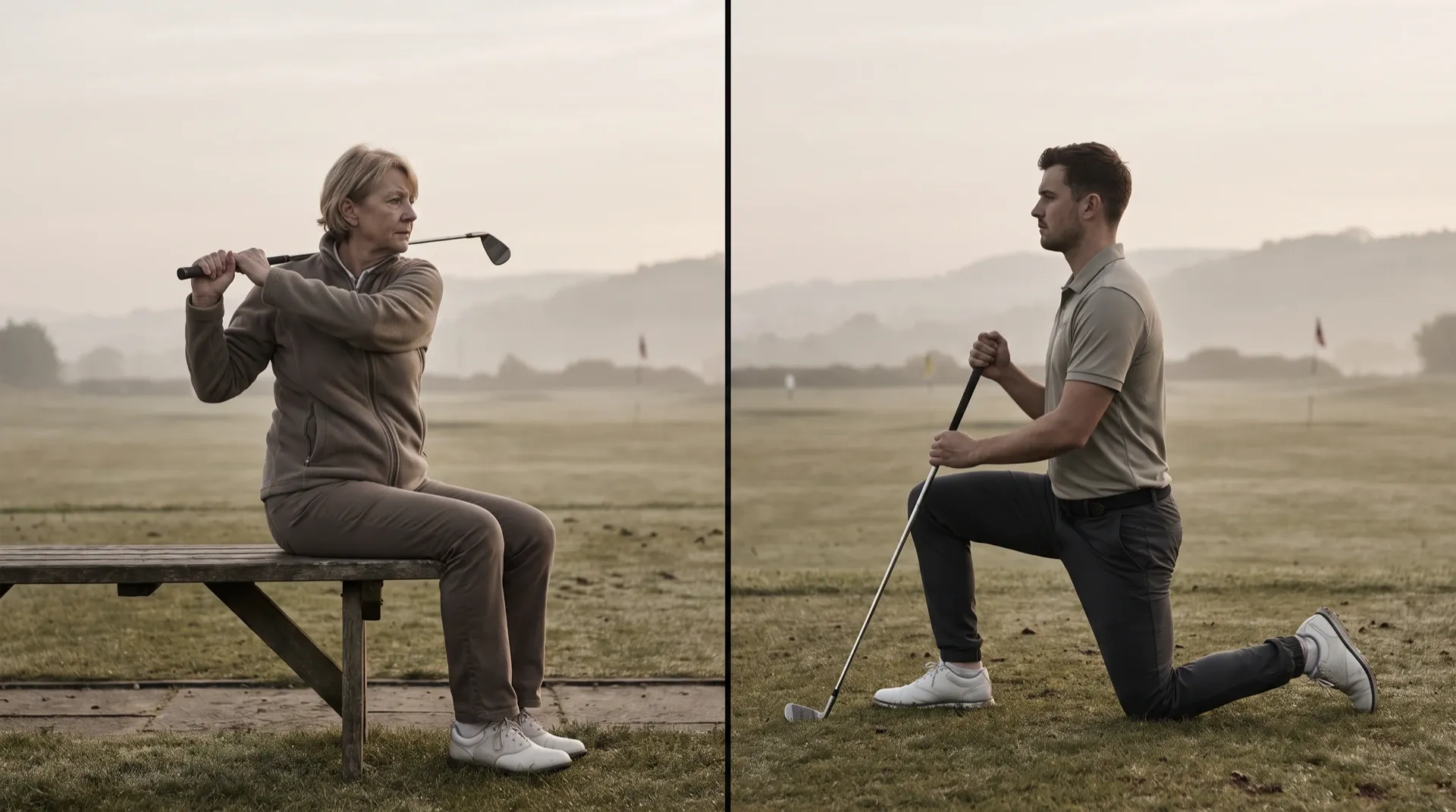
The stretches worth your week are the ones that open the ranges your swing loads hardest, starting with rotation in your lead hip. Timing matters as much as choice: move dynamically before you play, save the holds for after. That is a shorter list than most golf stretch articles hand you, and every item on it has a reason.
Murray, Birley, Twycross-Lewis and Morrissey (Physical Therapy in Sport, 2009) measured hip rotation in 64 amateur golfers at 2 clubs in southern England, 28 with self-reported low back pain and 36 without. The pain group averaged 21.1 degrees of passive lead-hip medial rotation, the controls 31.1. Non-lead hips showed no difference, and neither did rotation in the other direction. One hip, one direction.
Why the lead hip goes first
Gulgin, Armstrong and Gribble (North American Journal of Sports Physical Therapy, 2010) filmed 15 female collegiate golfers and compared the swing against each player's measured range. The downswing used 84 to 131 percent of the available internal rotation in the lead hip. The backswing used 20 to 25 percent of the trail hip's.
Of the hip rotations they measured, the lead hip is the one running at the edge of its range on every swing. The others had room to spare. Small sample, young right-handed women, so the exact percentages are theirs and not yours. The pattern is the useful part.
Vad and colleagues (American Journal of Sports Medicine, 2004) found the same joint from the other end. Of 42 professional male golfers, 33 percent had a low back pain history, and it correlated with less lead-hip internal rotation and less lumbar extension. Non-lead hip range showed nothing. Neither did how far they could reach toward the floor, worth remembering the next time a golf article opens with a toe-touch test.
Dynamic before you play, holds after
Gergley (Journal of Strength and Conditioning Research, 2009) gave 15 young male competitive golfers 2 warm-ups on separate days: an active dynamic warm-up with clubs, and that same warm-up with 20 minutes of total-body passive static stretching in front of it. The stretching version cost them 4.19 percent of clubhead speed, 5.62 percent of distance, 31.04 percent of accuracy and 16.34 percent of consistent ball contact. Honest limit: 20 minutes of passive stretching is a bigger dose than most golfers do, and these were young competitive players. The direction is clear even if the size isn't yours.
Holds are fine once the round is over. Behm and colleagues (Sports Medicine Open, 2023) pooled 47 studies and found a single bout of stretching gives a small range-of-motion gain, with no significant difference between techniques, intensities or durations. So don't overthink it. Get into the position, breathe, wait.
The 6 stretches
None of these should pinch. Stop any of them if you feel sharp pain or a line of pain running down a leg, and see a physio before you try that one again. Numbness, weakness in a leg, or any change in bladder or bowel control is a same-day call to a doctor rather than a stretching problem.
Hips
- 90/90 hip switch. Sit on the floor, both knees bent 90 degrees, one shin in front of you and the other out to the side. Chest tall. Rotate both knees over to the opposite side so the legs trade jobs. 2 sets of 8 switches, before you play. It asks both hips for internal and external rotation inside one movement. The full breakdown covers the cheats that make it useless.
- Seated lead-hip internal rotation. Sit on the front edge of a firm chair, feet flat and wider than your hips. Leave that foot exactly where it is and let the knee travel inward toward the midline, so the thigh rotates instead of the whole leg sliding across. Light hand pressure on the knee is fine. 3 holds of 30 seconds per side, after golf. This is the exact direction Murray's pain group was short on.
- Half-kneeling hip flexor reach. Kneel on your trail knee on a folded towel, other foot flat in front. Tuck your tailbone under until the front of that hip pulls, then reach the same-side arm overhead and lean gently away. 2 holds of 30 seconds per side, after golf. Cart seats and desk chairs hold this hip in a shortened position all day, and our coaching view is that a trail hip short on extension leaves the low back doing more of the work through the finish.
Mid-back
- Open book. Lie on your side, knees stacked and bent 90 degrees on a pillow, arms straight out in front. Keep the knees pinned together and open the top arm across your body, following your hand with your eyes, until the shoulder blade reaches the floor or gets as close as it can, then come back. 2 sets of 8 per side, before you play. If you failed the 45-degree seated test, do this one even on the days you skip the rest.
- Thoracic extension over a chair back. Sit in a firm chair with the top of the backrest at the bottom of your shoulder blades, hands behind your head, elbows pointing forward. Breathe out and drape your upper back over the backrest. 5 slow breaths, 3 times, after golf. Keep your ribs down; our coaching view is that it keeps the movement in the mid-back rather than letting it slide into the low back.
Shoulders
- Cross-body lead shoulder reach. Bring the lead arm straight across your chest at shoulder height and draw it in with the other forearm just above the elbow, never on the joint itself. 2 holds of 30 seconds per side, after golf. Your lead arm crosses your chest to get to the top of the backswing, and in our experience the lead shoulder is where golfers over 45 feel the pull first.
Test your lead hip in 30 seconds
Sit tall on a hard chair, feet flat, knees together and pointing straight ahead. Keeping the knees touching, let one foot swing out to the side as far as it goes without the knee lifting or the hip rolling back. That's internal rotation, so do both sides. For a right-handed golfer the lead hip is the left one.
If the lead side moves noticeably less, stretch 2 is your homework. Our coaching view is to give it 6 weeks before you judge whether it moved. One caveat: Murray's team measured with an inclinometer with the hip straight, not seated, so compare your two hips against each other, not against their 31 degrees.
Does any of this add distance?
Not on its own, and no study has shown that it does. The closest evidence is Doan, Newton, Kwon and Kraemer (Journal of Strength and Conditioning Research, 2006): 16 Division I golfers training strength, power and flexibility 3 times a week for 11 weeks. Every strength, power and flexibility test improved between 7.3 and 19.9 percent, and clubhead speed, a separate measure, rose 1.6 percent, worth about 4.9 meters of drive. Flexibility was one ingredient in a mixed program with no separate control group.
Mobility buys you the room to swing. Strength and speed work turn the room into yards, and the 8 exercises worth doing twice a week are the ones with pooled evidence behind them.
Go deeper
- The 45-degree seated test: how much mid-back rotation you need, and the 3 swing faults that appear without it.
- The 90/90 hip switch done right: stretch 1 above, and the compensations that waste your floor time.
- The 7-minute parking-lot warm-up: where the dynamic moves belong on a cold morning.
- The 3-minute cart reset: for when the low back tightens on the back nine.
What to do tomorrow
Do the 30-second chair test on both hips before anything else, and give stretch 2 the next 6 weeks if the lead side is the tighter one. Then run stretches 1 and 4 before your next round, and 2, 3, 5 and 6 after it. On a cold morning, fold the dynamic pair into the 7-minute parking-lot warm-up.
FitCaddie's Less Pain & Mobility program sequences this work across 6 weeks at 5 to 10 minutes a day, so you're not deciding what to stretch every morning.
Sources
- Murray E, Birley E, Twycross-Lewis R, Morrissey D. The relationship between hip rotation range of movement and low back pain prevalence in amateur golfers: an observational study. Physical Therapy in Sport. 2009;10(4):131-135. doi:10.1016/j.ptsp.2009.08.002
- Vad VB, Bhat AL, Basrai D, Gebeh A, Aspergren DD, Andrews JR. Low back pain in professional golfers: the role of associated hip and low back range-of-motion deficits. American Journal of Sports Medicine. 2004;32(2):494-497. doi:10.1177/0363546503261729
- Gulgin H, Armstrong C, Gribble P. Weight-bearing hip rotation range of motion in female golfers. North American Journal of Sports Physical Therapy. 2010;5(2):55-62. PubMed 21589662
- Gergley JC. Acute effects of passive static stretching during warm-up on driver clubhead speed, distance, accuracy, and consistent ball contact in young male competitive golfers. Journal of Strength and Conditioning Research. 2009;23(3):863-867. doi:10.1519/JSC.0b013e3181a00c67
- Behm DG, Alizadeh S, Daneshjoo A, et al. Acute effects of various stretching techniques on range of motion: a systematic review with meta-analysis. Sports Medicine Open. 2023;9(1):107. doi:10.1186/s40798-023-00652-x
- Doan BK, Newton RU, Kwon YH, Kraemer WJ. Effects of physical conditioning on intercollegiate golfer performance. Journal of Strength and Conditioning Research. 2006;20(1):62-72. doi:10.1519/R-17725.1
Questions golfers ask
Should I stretch before or after golf?
Move dynamically before, hold your stretches after. Gergley (2009) put 15 competitive golfers through an active dynamic warm-up with clubs, then repeated it with 20 minutes of total-body passive static stretching in front of it. The stretching version cost them 4.19 percent of clubhead speed, 5.62 percent of distance and 31.04 percent of accuracy. Save the held stretches for after the round or a separate session, when a temporary drop in power costs you nothing.
What is the best stretch for golfers?
If you do one, make it lead-hip internal rotation. Murray and colleagues (2009) measured 64 amateur golfers and found the 28 with low back pain averaged 21.1 degrees of passive lead-hip medial rotation, against 31.1 degrees in the 36 without it. Gulgin and colleagues (2010) found the downswing uses 84 to 131 percent of that joint's available internal rotation. Of the hip rotations that study measured, it's the one running closest to its limit, and it's the first thing we check in the golfers we work with.
How long should I hold a golf stretch?
30 seconds is plenty. Behm and colleagues (Sports Medicine Open, 2023) pooled 47 studies on a single bout of stretching and found the range-of-motion gain didn't differ significantly by technique, intensity or duration. Longer holds and fancier methods didn't come out ahead in that analysis. Our coaching view is that 3 holds of 30 seconds per side beats one 90-second grind, because you get 3 chances to settle into the position and breathe.
Will stretching add distance to my drives?
Not by itself. The closest evidence is Doan and colleagues (2006), where 16 collegiate golfers trained strength, power and flexibility together 3 times a week for 11 weeks. Their strength, power and flexibility tests improved 7.3 to 19.9 percent, and clubhead speed rose 1.6 percent, worth roughly 4.9 meters of drive. Flexibility was one ingredient in a mixed program with no separate control group, so stretching on its own has never been shown to add yards. Mobility buys you the room to swing. Strength and speed work turn the room into distance.
How often should I stretch for golf?
Our coaching view is at least 4 or 5 short sessions a week of 5 to 10 minutes, rather than one long weekend session. The dynamic moves get done on the days you play, in the parking lot before you tee off. The held stretches go after golf, or in the evening on days you don't play. Give any mobility change 6 weeks before you judge whether it worked.
Continue reading
More on Mobility
The 90/90 you've been doing wrong (and the fix)
The 90/90 hip switch is one of the most-prescribed mobility drills for golfers and one of the most-butchered. Three mistakes kill it. This is the version that changes your hip rotation, and why hip rotation matters for your low back.
One floor drill for three swing faults: thoracic rotation
Early extension, casting, and a fall-back finish often share a single cause, a mid-back that won't rotate. A 60-second seated test tells you if that's you, and the open book drill works on it in 4 minutes a day.
Read a guide, then run the routine.
Open FitCaddie for a short routine you can run before your next round.
Build my planNo inbox required · 7 days free · No card to start