
The 90/90 you've been doing wrong (and the fix)
The 90/90 hip switch is one of the most-prescribed mobility drills for golfers and one of the most-butchered. Three mistakes kill it. This is the version that changes your hip rotation, and why hip rotation matters for your low back.
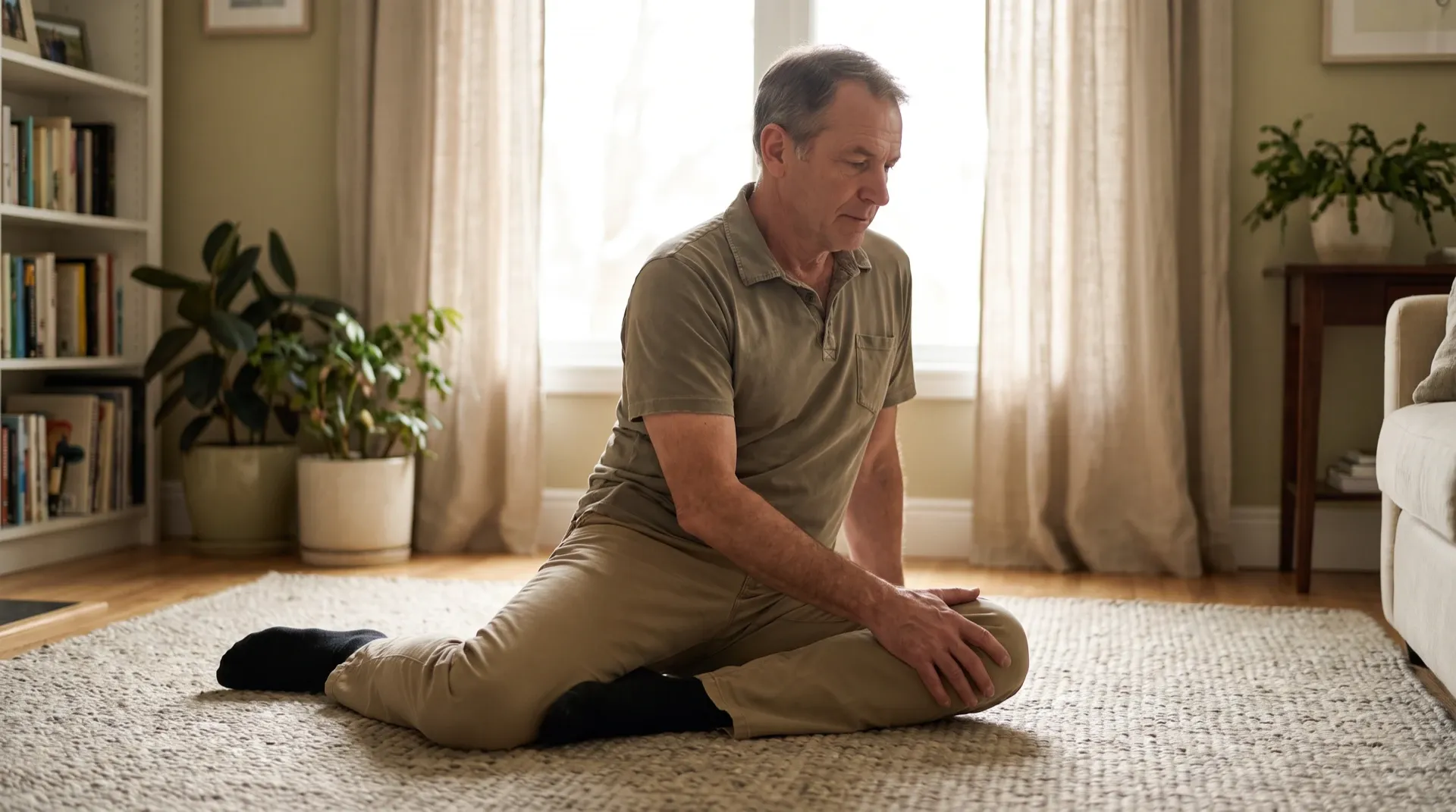
The 90/90 hip switch works when you sit tall, move slowly, and let the hips do the rotating. Most golfers slump back, lean toward the front leg, and rush the switch. That version looks like mobility work and changes almost nothing.
Why hip rotation protects your low back
Your lead hip (left hip for a right-handed golfer) has to rotate internally as you turn through impact. Your trail hip rotates internally on the way back. If either hip runs out of rotation, the next joint up takes over, and the next joint up is your lumbar spine.
Vad and colleagues (American Journal of Sports Medicine, 2004) screened 42 male professional golfers at a PGA Tour event. A third had a history of low back pain, and that history correlated with less internal rotation in the lead hip and less lumbar extension. It's a correlation in one group of pros, not proof of cause, but the authors' read was that when the lead hip can't rotate, the load moves to the low back. For golfers whose back complains, the 90/90 is aimed at exactly the restriction that study found. (If your back is already barking mid-round, the 3-minute cart reset is the companion piece.)
The three mistakes
- Sitting back instead of sitting tall. When your torso leans back and your weight goes into your hands, the front hip collapses and you lose the very rotation you're trying to build.
- Leaning toward the front leg. Folding your chest over the front shin feels like a deeper stretch. It's mostly your spine bending. The hip stopped moving a while ago.
- Switching too fast. The slow, controlled descent to each side is the whole drill. Count the seconds, not the reps.
The version that works
- Sit on the floor. Front leg bent 90 degrees, with the shin lying across in front of you so your foot points toward the opposite side. Back leg bent 90 degrees out to the side, with that shin pointing straight behind you.
- Sit as tall as you can. Hands on the floor behind you for balance only, not to hold your weight. If you can't sit tall, put a folded towel or yoga block under your hips.
- Lift both knees a few inches and take 3 full seconds to lower them to the other side. You're rotating both hips at once.
- Pause 1 second when the new front shin touches the floor.
- Take 3 more seconds to bring them back through. That's 1 switch.
Eight controlled switches is a set, about a minute. Do 1 to 2 sets a day. Breathe out on the way down.
If one side is noticeably tighter, spend an extra 30 seconds sitting tall in that position at the end of the set, without forcing anything. A dull stretch is fine. A sharp pinch deep in the hip, or pain that lingers after you stand up, means stop and get it looked at.
What the research says
- Lead hip rotation and low back pain are linked. Vad et al. (2004): among 42 male professional golfers, a history of low back pain correlated significantly with decreased lead hip internal rotation and decreased lumbar extension. Trail hip range showed no such link.
- The low back is golf's most common injury site. McHardy, Pollard and Luo's review (Sports Medicine, 2006) found the low back is the most frequently injured area in golfers, with the swing itself a major contributing factor.
What to do tomorrow
Film yourself from the side doing 3 switches. If your chest leans forward or your weight is in your hands, you're doing the version that changes nothing. Fix the posture first, then slow the reps down.
FitCaddie's Less Pain & Mobility program puts the 90/90 into a daily 5 to 10 minute session alongside the thoracic and low-back work that goes with it.
Sources
- Vad VB, Bhat AL, Basrai D, Gebeh A, Aspergren DD, Andrews JR. Low back pain in professional golfers: the role of associated hip and low back range-of-motion deficits. American Journal of Sports Medicine. 2004;32(2):494-497. doi:10.1177/0363546503261729
- McHardy A, Pollard H, Luo K. Golf injuries: a review of the literature. Sports Medicine. 2006;36(2):171-187. doi:10.2165/00007256-200636020-00006
Questions golfers ask
What does the 90/90 hip stretch do for golfers?
It trains internal and external rotation of both hips at the same time, under control. Those are the two hip motions the golf swing uses most: the lead hip rotates internally through impact and the trail hip rotates internally in the backswing.
How often should I do the 90/90?
Daily works, since it's low load. One set of 8 slow switches takes about a minute. Add a second set if hips are your main restriction.
Why does my hip pinch in the 90/90?
Usually because you're sitting back and letting the front hip collapse, or forcing range the joint doesn't have yet. Sit taller, shorten the range, and slow down. A sharp, deep pinch that doesn't ease with those changes is worth a physio visit.
Continue reading
More on Mobility
Golf stretches that earn a spot in your week
The stretches worth your time open the ranges the swing loads hardest. Murray et al. (2009) found amateur golfers with low back pain had 10 degrees less lead-hip rotation. Here are 6, and when to do each.
One floor drill for three swing faults: thoracic rotation
Early extension, casting, and a fall-back finish often share a single cause, a mid-back that won't rotate. A 60-second seated test tells you if that's you, and the open book drill works on it in 4 minutes a day.
Read a guide, then run the routine.
Open FitCaddie for a short routine you can run before your next round.
Build my planNo inbox required · 7 days free · No card to start