
Golfer's elbow exercises: 5 slow moves, plus when to keep playing
Golfer's elbow is an overloaded tendon, and the small studies we have point to slow daily loading. Tyler et al. (2014) saw disability scores fall from 34.7 to 7.9 after adding one eccentric drill to standard care.
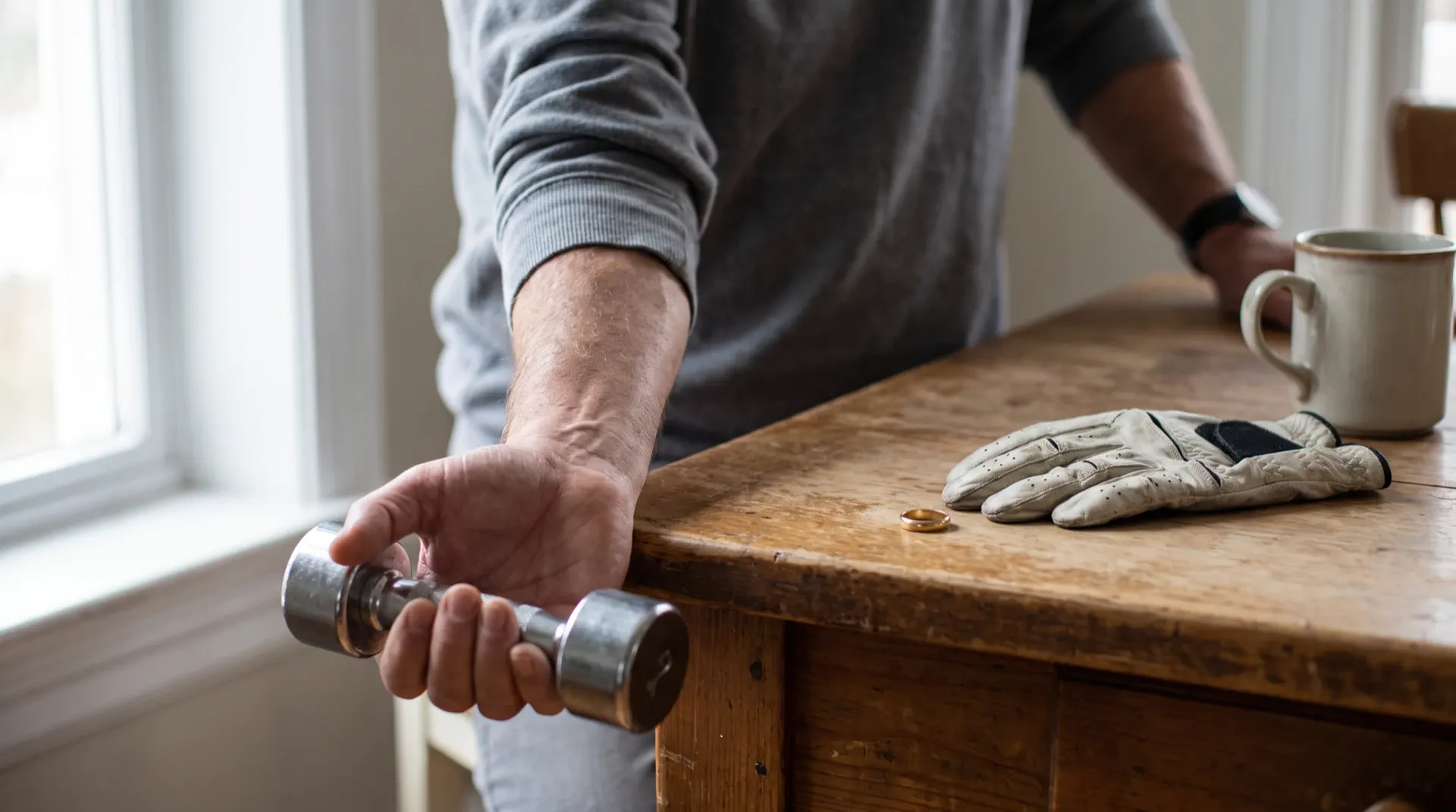
Golfer's elbow is an overworked tendon where the muscles that bend your wrist and turn your palm down anchor to the bony bump on the inside of the elbow. The evidence, a handful of small studies, points to slow, controlled loading of that tendon, done daily over 6 to 12 weeks. Rest alone rarely settles it in our experience. The 5 moves below take about 10 minutes and need a light dumbbell or a rubber bar, a hammer or a wedge, and something to squeeze.
Tyler and colleagues (International Journal of Sports Physical Therapy, 2014) took 20 patients with chronic medial epicondylosis (the tendon version of golfer's elbow) who had already failed physio, cortisone or anti-inflammatories. Golf was the activity that set it off for 14 of them. They added one eccentric wrist-flexor exercise with a rubber bar, 3 sets of 15 twice a day, to standard care, and disability scores on the DASH questionnaire dropped from 34.7 to 7.9 over an average of 6 weeks. No control group, so it can't separate the bar from the rest of the care.
What it usually is
Every swing asks the wrist flexors to fire hard at impact. Glazebrook and colleagues (American Journal of Sports Medicine, 1994) measured forearm muscle activity in golfers with and without inside-elbow pain and recorded a "flexor burst" at contact of 90.77 percent of maximum voluntary contraction. Golfers with the sore elbow ran higher flexor activity than those without, at address and through the swing.
Repeat that burst 80 times on a range mat and the tendon's capacity runs out before the bucket does. That's our coaching picture, and slow loading below the pain line is how you raise what it can give.
McHardy, Pollard and Luo (American Journal of Sports Medicine, 2007) followed 588 amateur golfers for a year: the elbow and forearm accounted for 17.2 percent of injuries, second only to the lower back at 18.3 percent. One wrinkle from McHardy and Pollard's 2005 review: outside-elbow pain (the tennis elbow side) outnumbers inside-elbow pain in golfers by about 5 to 1. The moves below are for the inside; outside-elbow pain uses the same idea with the wrist extensors, so the drills flip.
What it isn't, and when to stop
Dull inside-elbow pain that flares with gripping and eases with rest usually fits the tendon pattern, though other problems can look like it and only a clinician can tell them apart. See a physio or doctor first if you have any of these:
- numbness or tingling in the ring and little fingers (the ulnar nerve runs right past that bony bump)
- the elbow feels loose or gives way, or the pain came on with one swing and a pop
- swelling, heat, or pain that doesn't change with what you do or how you hold the arm
- pain that wakes you at night, or a fever
Stop the routine and get assessed if any of those show up. During any drill, sharp or shooting pain means stop. A physio rules those out, and an early visit is cheaper than 3 months of guessing.
The 5 moves
Once a day, in this order, on the sore arm. Moves 2 and 3 are the same drill with different kit, so pick one. An ache up to 3 out of 10 during the slow-lowering work is acceptable in our coaching view, as long as it's back to baseline by the next morning; if it isn't, halve the weight. That rule is borrowed from Achilles tendon rehab and a physio can overrule it; pain climbing week to week means a clinician. Tempos below are ours; the studies reported sets and reps.
- Wrist flexor stretch. Arm straight in front, palm up, other hand pulling the fingers gently back until you feel the inside of the forearm. 30 seconds, 3 times, a comfortable pull. It makes the loading feel better; on its own, the studies above don't show it does much.
- Reverse Tyler Twist. The exercise from the 2014 study: hold a flexible rubber bar upright in the sore hand, palm facing you, wrist bent toward you, then grab the top with the other hand, palm facing away, and twist the bar by bending that wrist. Extend both arms in front and let the sore wrist straighten over 4 seconds, resisting the bar as it untwists. 3 sets of 15 once a day; the study did it twice.
- Eccentric wrist curl over a table edge. Forearm on the table, palm up, hand off the edge holding a 2 to 5 pound dumbbell; lift the weight to the top with your other hand, then lower it on your own over 4 seconds, 3 sets of 15. This is our dumbbell take on the 3-month home eccentric program Svernlöv, Hultgren and Adolfsson (Shoulder & Elbow, 2012) gave 20 patients: pain fell significantly, grip strength rose, and pain was still significantly lower at a follow-up averaging 11 years. Small case series, no control group.
- Hammer rotations. Hold a hammer (or a wedge, grip end up) with the elbow bent 90 degrees and tucked to your side, and turn the palm down over 3 seconds, then back up over 3, 2 sets of 10. This works the pronator teres, the muscle Farber and colleagues (American Journal of Sports Medicine, 2009) found amateurs fire about twice as hard as pros in the trail arm during the forward swing (120.9 versus 57.4 percent of a max muscle test). Choke down if it aches.
- Slow grip squeeze. Squeeze a tennis ball or rolled towel for 5 seconds, release for 5. 2 sets of 10. This is your check-in: if a 5-second squeeze hurts more this week than last, back the other drills off.
About 10 minutes. The two studies above ran 6 and 12 weeks, so give it that long before you judge it. If nothing has moved in 4 weeks, see a physio.
What makes it come back
Fat shots off mats, a sudden jump in range volume, and a death grip. The first has a described mechanism; the other two are coaching experience. McHardy and Pollard (2005) describe inside-elbow injury in amateurs as usually happening at impact when the clubhead decelerates suddenly, and "the hitting of a 'fat' shot is the more likely mechanism."
The golfers we work with who get this are almost always the ones who went from 1 range session a month to 3 a week in April. On grip: firm enough that the club won't twist, and no firmer.
A forearm brace and a jumbo grip are comfort measures in our view. Glazebrook (1994) put both on symptomatic golfers and found no significant change in forearm muscle activity during the swing. A brace can make a round more comfortable; in that study it didn't measurably change what the forearm muscles were doing.
Can you keep playing?
Usually yes, with limits. Our coaching guideline (a physio can overrule it): play if the elbow stays under a 3 out of 10 during the round and is back to its pre-round baseline by the next morning. Skip the range mat for 4 weeks, hit off turf when you practise, and cap practice at half a bucket.
On cortisone, the best trial is on the outside-elbow cousin, and it isn't encouraging. Coombes and colleagues (JAMA, 2013) randomized 165 people with lateral elbow pain to a steroid or placebo injection, and at 1 year 54 percent of the steroid group had a recurrence versus 12 percent with placebo. That trial studied the outside of the elbow, so take it as a caution. Ask about that trade before you say yes.
What to do tomorrow
Start tonight with whichever kit you have (move 2 or 3) and run the routine before bed. Before your next round, run the 7-minute parking-lot warm-up so the first swings aren't cold ones, and if your low back complains too, the 3-minute cart reset pairs with this.
FitCaddie's Less Pain & Mobility program covers the rest of the body, with no elbow rehab in it: daily hip and mid-back work so the body turns through impact, which in our coaching view leaves the hands less to do, and pain-aware swaps that let you adjust the moves that bother a sore elbow. The 10 minutes above stays yours.
Sources
- Tyler TF, Nicholas SJ, Schmitt BM, Mullaney M, Hogan DE. Clinical outcomes of the addition of eccentrics for rehabilitation of previously failed treatments of golfers elbow. International Journal of Sports Physical Therapy. 2014;9(3):365-370. PMC4060314
- Glazebrook MA, Curwin S, Islam MN, Kozey J, Stanish WD. Medial epicondylitis. An electromyographic analysis and an investigation of intervention strategies. American Journal of Sports Medicine. 1994;22(5):674-679. doi:10.1177/036354659402200516
- McHardy A, Pollard H, Luo K. One-year follow-up study on golf injuries in Australian amateur golfers. American Journal of Sports Medicine. 2007;35(8):1354-1360. doi:10.1177/0363546507300188
- McHardy AJ, Pollard HP. Golf and upper limb injuries: a summary and review of the literature. Chiropractic & Osteopathy. 2005;13:7. doi:10.1186/1746-1340-13-7
- Svernlöv B, Hultgren E, Adolfsson L. Medial epicondylalgia (golfer's elbow) treated by eccentric exercise. Shoulder & Elbow. 2012;4(1):50-55. doi:10.1111/j.1758-5740.2011.00152.x
- Farber AJ, Smith JS, Kvitne RS, Mohr KJ, Shin SS. Electromyographic analysis of forearm muscles in professional and amateur golfers. American Journal of Sports Medicine. 2009;37(2):396-401. doi:10.1177/0363546508325154
- Coombes BK, Bisset L, Brooks P, Khan A, Vicenzino B. Effect of corticosteroid injection, physiotherapy, or both on clinical outcomes in patients with unilateral lateral epicondylalgia: a randomized controlled trial. JAMA. 2013;309(5):461-469. doi:10.1001/jama.2013.129
Questions golfers ask
How long does golfer's elbow take to heal?
Golfer's elbow improved over weeks to months in the studies we have. Tyler et al. (2014) measured a large drop in disability scores after an average of 6 weeks of eccentric loading added to standard care, and Svernlöv et al. (2012) measured lower pain after 12 weeks of home exercise. Our coaching estimate, and it varies a lot from golfer to golfer, is 6 to 12 weeks of daily work before you judge it. A case that hasn't moved after 4 weeks of consistent loading needs a physio, because inside-elbow pain has several other causes.
Should I stretch or strengthen golfer's elbow?
Golfer's elbow responds to slow strengthening, with a gentle stretch as the warm-up. Two small studies on the inside of the elbow, Tyler et al. (2014) and Svernlöv et al. (2012), both built their programs around eccentric loading: lowering a weight or releasing a twisted bar under control with the wrist flexors. Neither tested stretching on its own, and in our coaching view a stretch by itself won't change what the tendon can handle, which is the thing that ran out.
Can I play golf with golfer's elbow?
Most golfers can keep playing with golfer's elbow, within limits. Our coaching guideline (a physio can overrule it): play if the elbow stays under a 3 out of 10 during the round and is back to its pre-round baseline by the next morning. Skip range mats for 4 weeks, practise off turf, cap sessions at half a bucket, and keep doing the daily loading. Sharp pain on one swing, or numbness or tingling into the ring and little fingers, means stop and see a physio before the next round.
Do I need a FlexBar for the Reverse Tyler Twist?
A FlexBar is what Tyler et al. (2014) used, and it's cheap rehab kit, but the dumbbell version over a table edge trains the same slow, lengthening wrist flexion. Svernlöv et al. (2012) got significant pain reduction and grip strength gains from a 3-month home eccentric program. Pick one version, bar or dumbbell, and do it every day, because the daily part is what the studies had in common.
Does a brace help golfer's elbow?
A forearm brace can make gripping and playing more comfortable, and there's nothing wrong with wearing one for a round. Glazebrook et al. (1994) tested a forearm brace and an oversized grip on golfers with medial epicondylitis and found no significant change in forearm muscle activity during the swing, so in that study a brace didn't measurably change what the muscles did at impact. Wear it if it helps. Do the loading either way.
Continue reading
More on Pain
Read a guide, then run the routine.
Open FitCaddie for a short routine you can run before your next round.
Build my planNo inbox required · 7 days free · No card to start