
What 'active recovery' actually means after 18 holes
Active recovery is low-intensity movement after exercise instead of sitting still. For golf, that's 20 minutes of easy walking, slow mobility, and breathing in the half hour after your round. Dupuy et al. (2018) found it eases delayed-onset soreness. This is the protocol, and what it won't do.
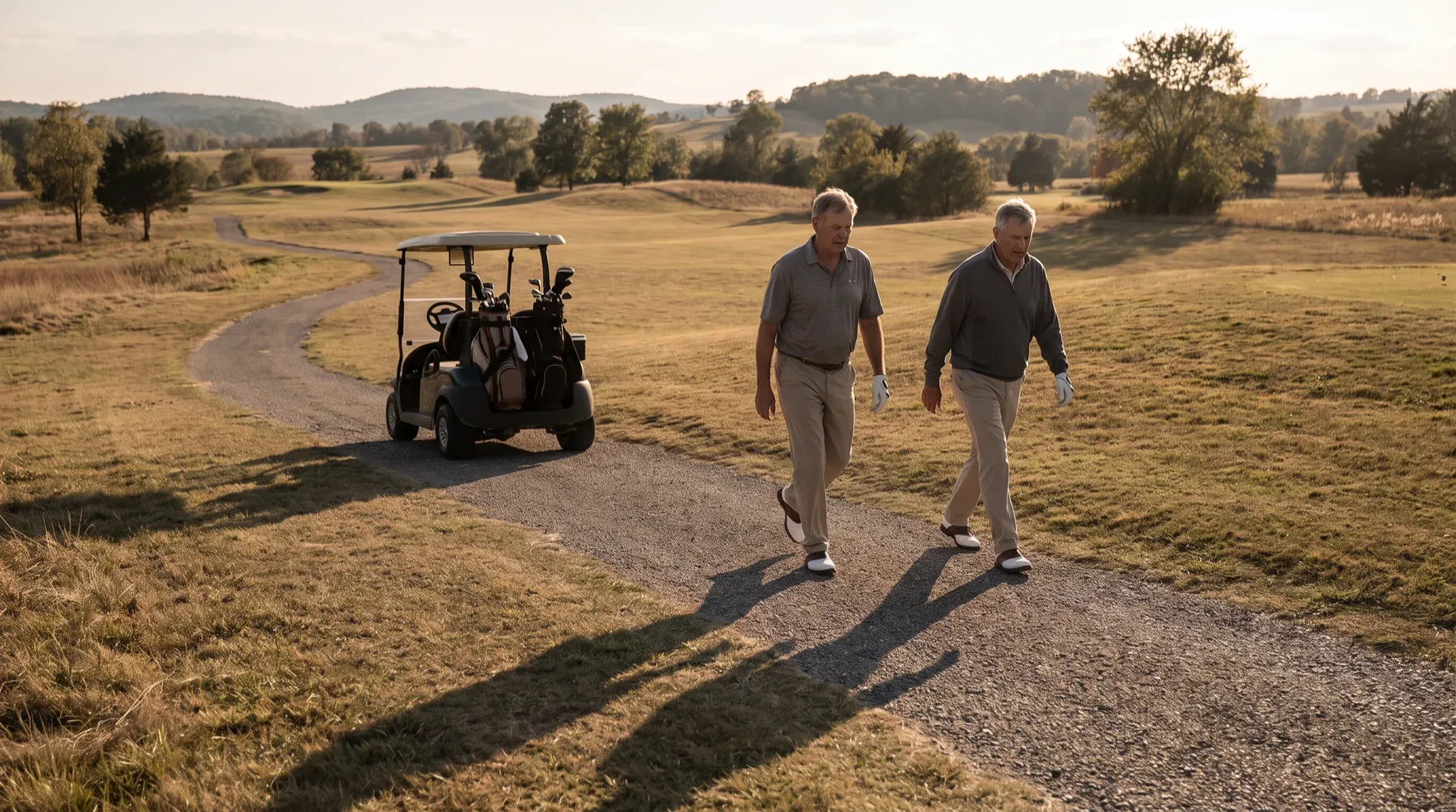
Active recovery means low-intensity movement in the window after exercise instead of sitting still. For golf, our version is about 20 minutes of easy walking, slow mobility, and breathing, done before you sink into the clubhouse chair. Dupuy and colleagues' 2018 review of 99 studies found active recovery eases delayed-onset muscle soreness. It won't make you less tired tonight, and it's not a substitute for sleep.
What a round does to your body
A round of golf is 4 to 5 hours of mostly standing and sitting, interrupted by somewhere between 40 and 90 full swings depending on how you're playing, each one a hard rotation in the same direction. Your nervous system stays switched on the whole time, because every shot matters. Your hips spend hours flexed in a cart seat. One side of your trunk does far more work than the other.
Then the usual move is straight from the 18th green to a chair, where you stop moving completely. In our experience, the stiffness you feel the next morning is partly the round and partly those first 30 minutes after it.
The 20-minute protocol
Do this within 30 minutes of your last putt. Nothing here should feel like exercise.
- Minutes 1 to 5: easy walking. Flat ground, conversation pace. A loop of the clubhouse, the parking lot, or the range. If you rode a cart all day, this matters more. You're moving blood through tissue that's been static.
- Minutes 6 to 15: slow mobility, two rounds. Move each area through its range, slowly, without holding or forcing. Run the list twice, about 5 minutes a round:
- Cat-cows, 10 reps, hands on a bench or the cart
- Hip circles, 5 each direction, each leg
- Ankle circles, 10 each direction
- Shoulder rolls, 10 forward, 10 back
- Slow neck nods and turns, 5 each way
- Standing side bends, 3 breaths each side
- Minutes 16 to 20: nasal breathing, sitting tall. Sit up straight, close your mouth, and breathe in and out through your nose. Make the exhale longer than the inhale. This is the signal to your nervous system that the round is over.
Then the beer, if you want it.
What Dupuy's review found
Dupuy, Douzi, Theurot, Bosquet and Dugué (Frontiers in Physiology, 2018) pooled 99 studies on post-exercise recovery methods. On delayed-onset muscle soreness, active recovery produced a large reduction (Hedges' g = -0.94), second only to massage (g = -2.26). Compression garments and cold-water immersion also helped, with smaller effects. Massage came out as the single most effective method for both soreness and fatigue.
Two caveats from the same review. Active recovery did not reduce perceived fatigue, so if you're wiped out after a round, movement won't change that. And stretching as a recovery method showed no significant effect on soreness or fatigue, which is why the protocol above moves through ranges instead of holding them.
One caveat from us. Those 99 studies used lab exercise protocols designed to make people sore, not rounds of golf. We're applying the finding to golf because the mechanism, easy movement after hard asymmetric work, is the same. Nobody has run the trial on golfers.
When a walk isn't enough
If you're playing two days in a row, or you're over 55 and Sunday after Saturday golf is a write-off, add massage. It was the strongest method in the Dupuy review for soreness and for fatigue. A massage gun or foam roller on the glutes, lats and mid-back for 10 minutes is the home version. Cold-water immersion helped fatigue more than active recovery did, if you have access to a cold plunge and the stomach for it. Stack either one on the walk.
And if the same spot hurts after every round, mobility during the week is the answer. Start with the 90/90 for hips and the open book for the mid-back.
What to do tomorrow
Before your next round, decide where you'll do the 5-minute walk, so you don't have to think about it when you're tired. Then do the full 20 minutes once and compare how Monday morning feels against a normal one.
FitCaddie's Play tab has a post-round recovery flow built on this protocol, and every program includes a recovery day so Saturday doesn't wreck Sunday.
Sources
- Dupuy O, Douzi W, Theurot D, Bosquet L, Dugué B. An evidence-based approach for choosing post-exercise recovery techniques to reduce markers of muscle damage, soreness, fatigue, and inflammation: a systematic review with meta-analysis. Frontiers in Physiology. 2018;9:403. doi:10.3389/fphys.2018.00403
Questions golfers ask
What is active recovery?
Low-intensity movement done after exercise instead of sitting still: easy walking, light cycling, slow mobility work. In the research it's defined against passive recovery, which is doing nothing.
Does active recovery actually work?
For soreness, yes. Dupuy and colleagues' 2018 meta-analysis of 99 studies found active recovery produced a meaningful reduction in delayed-onset muscle soreness. It did not reduce perceived fatigue, so expect to feel less stiff tomorrow, not less tired tonight.
Is a beer after golf bad for recovery?
One beer isn't going to undo your round. The problem is the couch that comes with it. Do the 20 minutes of movement first, then sit down. The order matters more than the drink.
Read a guide, then run the routine.
Open FitCaddie for a short routine you can run before your next round.
Build my planNo inbox required · 7 days free · No card to start