
The pre-shot routine that survives bogey-bogey-double
A pre-shot routine that holds up after a bad stretch has three anchors: a fixed physical sequence, one breath, and a short verbal cue. Rupprecht, Tran and Gröpel's 2021 meta-analysis found routines help under pressure as much as without it.
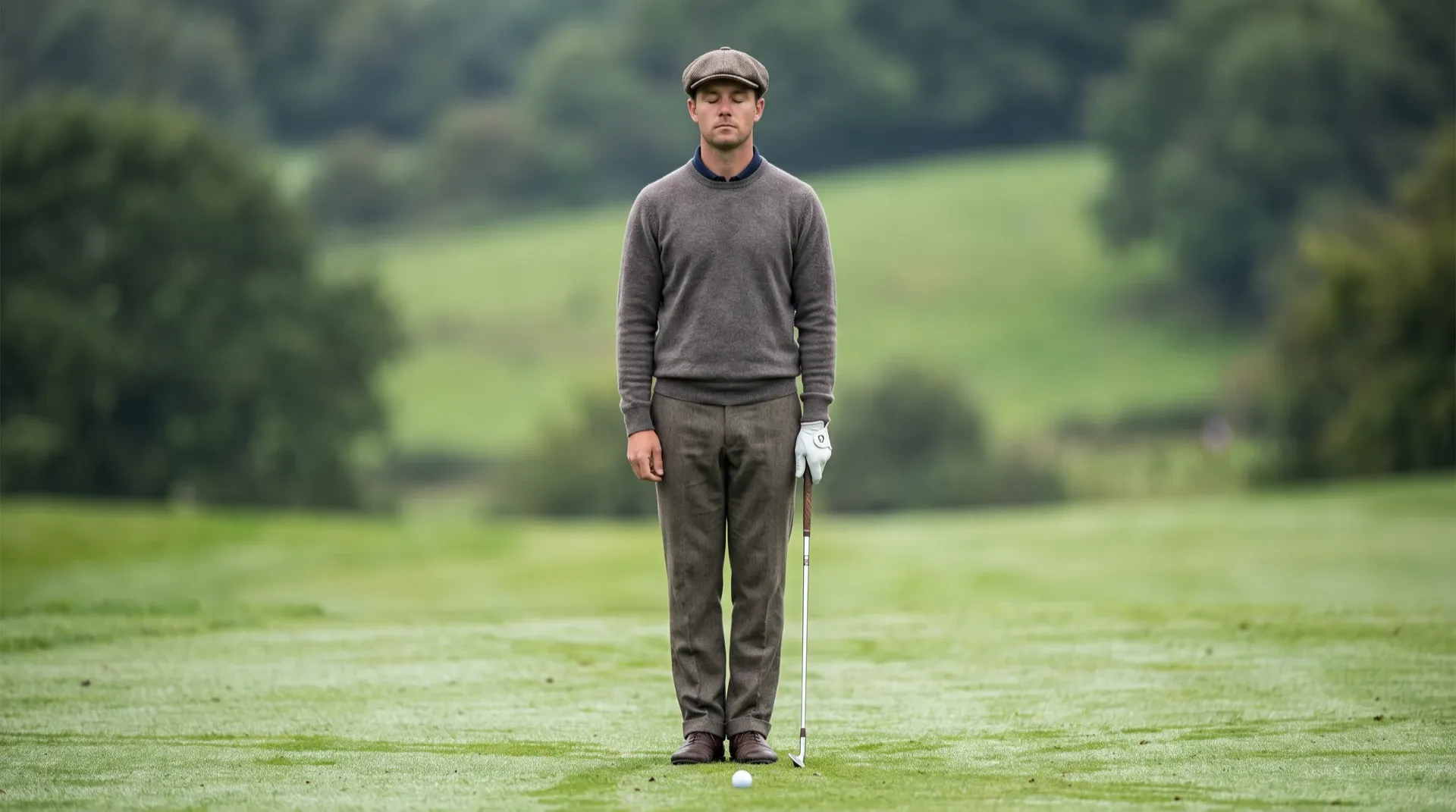
A pre-shot routine is a small ritual that tells your nervous system, "we know what to do here." On the 4th hole, when you're two over and relaxed, almost any routine works. After bogey-bogey-double, the body forgets, the mind speeds up, and a routine that was never built on purpose collapses. The one that survives has three anchors: a physical sequence, one breath, and a short verbal cue.
Why routines matter most when things go wrong
Sport psychologists call it a pre-performance routine. Moran (1996) defined it as a sequence of task-relevant thoughts and actions an athlete goes through systematically before a skill, and Cotterill's 2010 review of the field adopted that definition. Golf gives you 20 seconds before every shot to run one.
Rupprecht, Tran and Gröpel (International Review of Sport and Exercise Psychology, 2021) pooled 112 effect sizes from routine studies across 15 sports. In experimental designs, routines produced moderate-to-large performance gains, and the effect under pressure (Hedges' g = 0.70) was as large as the effect without pressure (g = 0.64). Simple before-and-after designs showed a smaller effect (0.31). The analysis found no moderating effect of routine type, age, gender or skill level, which means most routines worked for most athletes in the pool.
The routine is for the 14th tee after three bad holes.
The three anchors
Anchor 1: the physical sequence
The same actions, in the same order, every shot. For example:
- Pick the club and commit to it. No second guess.
- Stand behind the ball and pick a specific target, not a general direction.
- One glove tug or one club waggle, whatever your reset gesture is.
- Two practice swings at the tempo you want.
- Walk in, set the clubface, then take your stance.
Keep the steps identical. Under pressure your body will do what it has rehearsed most, so rehearse the same thing.
Anchor 2: one breath
As you take your last look at the target, one long exhale through the nose. Longer out than in. One breath won't calm you down after a double, but it puts a fixed pause in the routine where speeding up usually happens, and it gives you something to do with the surge of adrenaline.
Anchor 3: a short verbal cue
Say one short phrase to yourself, the same one every shot. Pick something neutral and physical: "smooth and committed," "tempo, target," "easy through." Avoid anything with a negative in it. "Don't hook it" puts the hook in your head as the last image before you swing.
Building it so it holds
Practice the routine on the range on every ball, including the warm-up balls. Time it once with your phone. In our experience 15 to 25 seconds from club selection to takeaway is the workable window. If it drifts longer, trim it. If it's under 10, you're probably skipping the target step.
Then test it on purpose. Play a practice round where you run the full routine on every shot, especially after a bad hole. Notice which anchor you drop first when you're angry. That's the one to rehearse more.
Where the body comes in
A routine can't fix a body that's stiff and gassed on the back nine. If your bad stretches cluster after hole 12, the problem may be physical before it's mental: cold tissue at the start and fatigue at the end. A real warm-up and a mid-round reset give the routine a body that can execute it.
What to do tomorrow
Write your three anchors on a card and put it in your bag. On your next range session, run the full routine on every ball. After bogey-bogey-double in your next round, run all three anchors on the next tee before you let yourself think about the score.
Sources
- Rupprecht AGO, Tran US, Gröpel P. The effectiveness of pre-performance routines in sports: a meta-analysis. International Review of Sport and Exercise Psychology. 2021. doi:10.1080/1750984X.2021.1944271
- Cotterill S. Pre-performance routines in sport: current understanding and future directions. International Review of Sport and Exercise Psychology. 2010;3(2):132-153. doi:10.1080/1750984X.2010.488269
- Moran AP. The Psychology of Concentration in Sport Performers: A Cognitive Analysis. Hove: Psychology Press; 1996.
Questions golfers ask
Do pre-shot routines actually improve golf performance?
Yes. Rupprecht, Tran and Gröpel's 2021 meta-analysis of 112 effect sizes across 15 sports found pre-performance routines produced moderate-to-large performance gains in experimental studies, and the effect under pressure (Hedges' g = 0.70) was as large as without pressure (g = 0.64). Effects held across routine types.
How long should a pre-shot routine be?
Short enough to repeat identically 70 times a round without slowing play. In our coaching experience most golfers land between 15 and 25 seconds from club selection to takeaway. Consistency matters more than length.
What should I say to myself before a golf shot?
Something neutral and physical, three words or fewer, the same every time. 'Smooth and committed' or 'tempo, target' work. Avoid negatives like 'don't hook it,' which put the miss in your head as the last picture before you swing.
Read a guide, then run the routine.
Open FitCaddie for a short routine you can run before your next round.
Build my planNo inbox required · 7 days free · No card to start